Natural diamond pricing can feel confusing because there isn’t a single “official” retail price. Two natural diamonds can look similar and still be priced very differently due to cut precision, proportions, certification details, and market demand around popular sizes.
This guide explains how natural diamond pricing works in 2026, how to interpret price ranges by carat, and how to verify certificates using official lab databases. It’s designed to help buyers make a confident decision—without relying on sales claims.
If you want to compare real listings while reading, you can filter and compare natural loose diamonds by shape, carat, color, clarity, cut, and certification on GEMGEM here: https://gemgem.com/en/category/diamonds
1) Why natural diamond prices don’t behave like gold or stocks
Natural diamonds are priced more like real estate than commodities. A home’s price isn’t only “size”—it’s layout, condition, location, timing, and buyer demand. Similarly, a natural diamond’s price isn’t only “carat”—it’s the full quality profile, how it performs visually, and proof (certificate + verification).
That’s why a “cheap” natural diamond may not be a good deal, and a higher-priced one may be justified if it has stronger light performance, better proportions, or clearer documentation. The goal of transparency is not to find the lowest number—it’s to understand whether the price makes sense for what you’re buying.
Comparison Table — Natural Diamonds vs Commodity Pricing
| Topic | Natural Diamonds | Gold/Stocks | Buyer Implication |
|---|---|---|---|
| What sets price | Quality profile + demand | Standardized unit | Compare within a peer set |
| Price variance | High (even within same carat) | Lower for same unit | “Cheap” may hide tradeoffs |
| Proof required | Certificate + verification | Market quote | Verification matters |
2) The 4Cs — and which “C” moves natural diamond price the most
Most people know the 4Cs: Carat, Cut, Color, Clarity. In practice, they don’t impact price equally.
Comparison Table — Which “C” Moves Price Most
| Factor | Typical Price Impact | Why | Practical Buyer Move |
|---|---|---|---|
| Carat | Very high | Rarity + milestone demand | Consider just-under milestone weights |
| Cut (esp. Round) | High | Visible performance | Prioritize cut for best value |
| Color | Medium–high | Demand bands | Consider G–H for value |
| Clarity | Medium | Eye-clean matters | Target VS2–SI1 carefully |
3) Wholesale benchmarks vs retail pricing (and why you see “different prices” everywhere)
Natural diamond pricing has layers:
- Trade benchmarks (wholesale reference points): In the trade, one widely referenced benchmark is the Rapaport Price List (commonly used as a reference point for assessing market values, with limitations). This is not the same as final consumer checkout pricing.
- Retail pricing (what most consumers see): Typically includes sourcing/inventory costs, platform costs, marketing/ops, payment processing, returns risk, customer service, and margin.
- Resale / marketplace pricing: In secondary markets, pricing can differ again. This is one reason marketplaces can sometimes offer meaningful value—when the listing is well documented and the buyer is protected.
Comparison Table — Benchmark vs Retail vs Marketplace
| Layer | What it is | Who uses it | Why prices differ |
|---|---|---|---|
| Trade benchmark | Reference point | Dealers/trade | Negotiation baseline, not checkout price |
| Retail | Consumer checkout pricing | Retailers | Overhead, services, returns risk |
| Marketplace/resale | Secondary market listings | Sellers/buyers | Liquidity + broader price dispersion |
4) 2026 price range examples by carat
The ranges below are illustrative and meant to show how pricing typically behaves in the US online market in 2026 for certified natural diamonds. Exact pricing depends heavily on shape, cut precision, and certificate details.
Use price ranges correctly:
- Compare the same shape
- Stay within a narrow carat window (e.g., 0.90–1.10ct)
- Compare similar color + clarity
- Compare cut quality (especially for rounds)
- Confirm certification (GIA/IGI) and verify report details
Comparison Table — Typical Online Asking Ranges (Natural Diamonds, 2026)
| Shape / Peer Example | Carat Window | Example Spec Band | Typical Online Range |
|---|---|---|---|
| Round Brilliant (highest demand) | 0.50–0.70ct | G–H, VS2–SI1, Excellent | $1,200–$3,200 |
| Round Brilliant | 0.90–1.10ct | G–H, VS2–SI1, Excellent | $3,800–$7,800 |
| Round Brilliant | 1.40–1.60ct | G–H, VS2–SI1, Excellent | $7,500–$15,500 |
| Round Brilliant | 1.90–2.10ct | G–H, VS2–SI1, Excellent | $14,000–$32,000 |
| Oval (often lower than round) | 0.90–1.10ct | G–H, VS2–SI1 | $3,200–$6,800 |
| Oval | 1.40–1.60ct | G–H, VS2–SI1 | $6,500–$13,500 |
| Emerald / Cushion (varies by “make”) | 1.40–1.60ct | G–H, VS2–SI1 | $6,200–$14,500 |
| Emerald / Cushion | 1.90–2.10ct | G–H, VS2–SI1 | $12,000–$28,000 |
5) The “hidden levers” that change natural diamond price more than most buyers expect
(1) Milestone weights
Prices often jump at 1.00ct / 1.50ct / 2.00ct. If you want better value with very similar face-up size, consider:
- 0.90–0.99ct
- 1.40–1.49ct
- 1.90–1.99ct
(2) Proportions (not just cut grade)
Two natural diamonds can both be “Excellent” cut and still differ materially based on depth %, table %, measurements, symmetry/polish, crown and pavilion angles (if available).
(3) Fluorescence
Fluorescence isn’t automatically bad, but it can affect appearance and pricing, especially at stronger levels. Consider it alongside certificate details.
(4) “Eye-clean” clarity vs paper clarity
A natural diamond can be SI1 and still look clean to the naked eye depending on inclusion location. Conversely, a VS stone can sometimes show a visible inclusion if it’s positioned prominently. This is why detailed listing data and high-quality imagery matter.
6) GIA and IGI reports: what a certificate does (and doesn’t do)
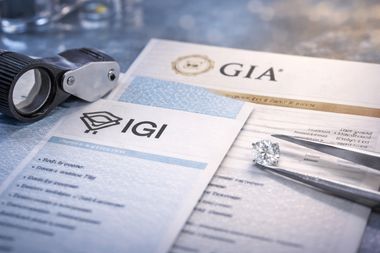
A grading report is a critical part of natural diamond transparency because it documents core quality details such as carat, color, clarity, cut (for rounds), fluorescence, measurements, and more.
Comparison Table — What a Certificate Does vs Doesn’t Do
| A certificate DOES | A certificate DOESN’T |
|---|---|
| Creates a standardized quality record | Guarantee the listing is honest (unless chain-of-custody is controlled) |
| Allows third-party verification via lab database | Ensure you like how the stone looks in real life |
| Helps reduce spec ambiguity | Eliminate swap risk without proper verification controls |
7) How to verify a report number (in minutes)
If a natural diamond is certified, verifying the report is one of the simplest ways to reduce risk.
- Verify a GIA report: use GIA Report Check and confirm report details match the listing
- Verify an IGI report: use IGI Verify Your Report and confirm validity and details
8) A practical “fair price” checklist (before you buy)
Before purchasing a natural diamond, use this checklist:
- Match the spec set
- Shape, narrow carat window, color, clarity, cut (if applicable), fluorescence
- Verify the report number
- Confirm with GIA/IGI official databases
- Compare within a narrow peer group
- Don’t compare a 1.00ct D VVS1 to a 1.00ct H SI1
- Watch milestone jumps
- Consider just-under weights for value
- Use a side-by-side peer set to judge value
9) Mini Peer Set Summary
A practical way to judge fairness is building a tight peer set (same shape + carat window + grades) and comparing multiple options side-by-side.
Mini Table — Common Peer Sets (Natural Diamonds)
| Use Case | Shape | Carat Window | Color/Clarity Example | Cut | Why it Works |
|---|---|---|---|---|---|
| Around 1ct (apples-to-apples) | Round | 0.90–1.10ct | G–H / VS2–SI1 | Excellent | True comparables around 1ct |
| Value under milestone | Round | 0.90–0.99ct | G–H / VS2–SI1 | Excellent | Similar look, often lower premium |
| Avoid 1.50 premium | Round | 1.40–1.49ct | G–H / VS2–SI1 | Excellent | Similar presence, less milestone demand |
If you want to compare real inventory using peer sets, you can do it directly on GEMGEM’s natural loose diamond marketplace page: https://gemgem.com/en/category/diamonds
10) Frequently Asked Questions (Natural Diamonds)
What is a fair price for a 1 carat natural diamond in 2026?
A fair price depends on shape, cut precision, color, clarity, fluorescence, and certificate details. Compare within a narrow band (e.g., Round 0.90–1.10ct, G–H, VS2–SI1, Excellent) to identify realistic pricing.
Why do natural diamond prices jump at 1.00ct and 2.00ct?
These are demand milestones. Many buyers search exactly for “1 carat” or “2 carat,” which increases competition and often pushes prices upward.
Is a natural diamond certificate the same as authentication?
A certificate is a grading report. Authentication typically involves ensuring the stone matches the listing and maintaining chain-of-custody controls. A certificate helps, but it isn’t the entire protection.
How do I verify a GIA report number?
Use GIA’s official Report Check tool and confirm the report details match the listing.
How do I verify an IGI report number?
Use IGI’s official Verify Your Report tool and confirm validity and details.
Does cut matter more than color?
Cut strongly impacts brilliance and sparkle. Many buyers achieve strong value by staying in near-colorless ranges (like G–H) while prioritizing excellent light performance.
What clarity is best value for money?
Often VS2–SI1 can be a strong value range, but it depends on inclusion type and placement. Prioritize eye-clean appearance and compare within a narrow peer group.
Are oval natural diamonds cheaper than round?
Often yes, because round brilliant natural diamonds have the highest demand and frequently command higher prices at similar specs.
How these 2026 price ranges were built
Natural diamond pricing does not have a single “official” consumer price. The ranges in this guide are designed to reflect typical US online market behavior in 2026 for certified natural diamonds—so buyers can judge whether a listing is within a realistic peer band, not whether it is the absolute lowest price.
Methodology (what we did):
- Define a peer set first (apples-to-apples)
- Collect a broad set of comparable asking prices (publicly visible US online retailer/marketplace environments)
- Clean the data (exclude mismatches, extreme outliers, brand-premium pricing)
- Summarize as a “typical band,” not a promise (because two natural diamonds with the same 4Cs can still differ materially)
Data sources used:
- Public US online listings from large e-commerce retailers and diamond marketplaces (asking prices for comparable certified natural diamonds)
- Trade/benchmark context from industry references commonly used by the trade (background only, not checkout pricing)
- Lab verification tools (GIA/IGI) to confirm meaning of reported grades and reduce report-detail mismatch risk
Last updated: March 2026