Buying pre-owned diamond jewelry can feel intimidating, especially when the purchase involves meaningful money and something as personal as fine jewelry. Many buyers worry about authenticity, undisclosed damage, inaccurate grading, or whether the item will match what’s described online.
Those concerns are valid. The good news is that buying pre-owned doesn’t have to be risky. What creates risk is missing proof: unclear documentation, incomplete condition details, or a marketplace process that forces you to rely on trust alone. When verification is done properly, pre-owned jewelry can be a smart way to access authentic natural diamonds with confidence.
This guide explains what to check before you buy, where problems typically happen, and how professional authentication reduces uncertainty.
What most buyers get wrong about “pre-owned”
Pre-owned isn’t the problem, unverified is
Pre-owned jewelry is not automatically risky. The real risk comes from buying pieces with:
Unclear item history
Vague listing details
No independent review of the stone and setting
No process for confirming the item matches its claims
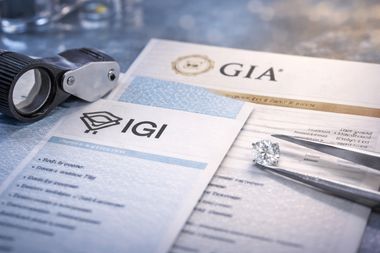
A certificate is helpful, but not the whole story
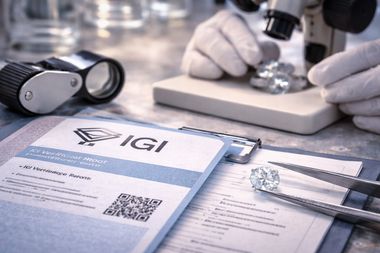
A lab report helps you understand diamond quality. But it doesn’t automatically confirm that the diamond in the setting today is the same stone described on paper years ago. That’s why authentication matters, it’s the step that checks whether the jewelry you’re buying matches what’s being claimed.
If you want a clear breakdown of what authentication involves, start with IGI verification and authentication.
Price should never come before proof
It’s easy to compare prices across listings, but price is not a safety signal. A safer approach is:
Verify the claims
Confirm condition
Confirm the process protects you
Then decide whether the piece is right for you.
The 3 proof layers you should look for
When buying pre-owned diamond jewelry safely, you’re looking for three layers of proof:
1) Documentation (what the item is)
Look for:
Any lab report (GIA/IGI, if available)
Clear grading details (shape, carat, color, clarity, cut)
Metal type and hallmark details (e.g., 14K/18K/PT950)
Dimensions and setting style (important for wearability and resizing)
If you’re unsure how to think about lab differences, this guide helps: diamond certification basics.
2) Condition transparency (what shape it’s in)
Pre-owned jewelry can be in excellent condition, but it should be described precisely. Look for:
Clear photos from multiple angles (including prongs and underside)
Disclosure of chips, abrasions, loose prongs, thinning bands, and worn pavé
Clarity on repairs, resizing, or replaced parts
Any mention of treatments (when applicable)
If a listing is vague about the condition, assume you don’t have enough information yet.
3) Process verification (whether you’re protected)
This is the part buyers often overlook. Ask: What happens between “I pay” and “I receive”?
A safer marketplace process typically includes:
Independent inspection before the buyer receives the item
Verification that the stone and setting match the listing claims
Documented checks and a clear resolution path if something doesn’t match
On GEMGEM, the trust model is designed to reduce the “random seller risk” through verification steps and professional authentication, rather than asking buyers to rely on seller reputation alone.
What can go wrong when verification is skipped?
Most buyer regret in the pre-owned market comes from the same predictable gaps:
The stone doesn’t match the claim
Examples:
The diamond is not the same size/grade as described
The stone was swapped over time
The report exists, but the mounted stone doesn’t match it
Damage is hidden by photos or angles
Examples:
Worn prongs that increase loss risk
Chips near the girdle
Thinning shank from repeated resizing
Pavé stones missing or loose
The listing is incomplete
Examples:
No confirmation of metal purity
Unclear measurements
“Estimated” details presented as facts
A cautious buyer doesn’t need perfect certainty, but you do need a process that reduces unknowns in the right places.
A practical checklist before you buy
Use this checklist for any pre-owned diamond jewelry purchase:
Step 1: Confirm the item identity
Do you have clear specs (carat, shape, metal, setting style)?
Are there close-up photos and measurements?
Step 2: Separate grading from matching
A report explains quality.
Authentication confirms the item matches the claim.
Step 3: Review conditions like an owner, not a browser
Inspect prongs, band thickness, pavé, symmetry, and wear points.
Look for clarity on prior resizing or repairs.
Step 4: Check return and dispute clarity
Even in a trusted marketplace, you should understand what happens if:
The item fails verification/authentication
The condition isn’t as described
Key specs don’t match the listing
Step 5: Prefer verified categories when browsing
If you’re early in your search, it’s often easier to start with curated categories:
These entry points help you compare listings with a similar structure, which makes verification details easier to evaluate.
Step 6: Don’t rush the decision
High-value jewelry buying is not “click-to-buy.” A confident purchase usually comes from:
Reading the specs calmly
Confirming documentation
Verifying the process protects you
Step 7: Choose a marketplace model built for verification
The safest pre-owned purchases happen when the marketplace is designed around:
Transparency
Inspection and authentication
Process clarity, not just listing volume.
How GEMGEM reduces risk without turning the page into an ad
A marketplace can feel “safe” or “unsafe” based on what it verifies. GEMGEM is structured to reduce common pre-owned risks by emphasizing:
Clear listing requirements
Verification steps that help ensure the item matches its description
Professional authentication as a trust layer before delivery
If you’re trying to build confidence, start by understanding what authentication actually checks and why it matters. Here’s the reference: IGI verification and authentication.
Conclusion: pre-owned can be safe when the proof is real
Buying pre-owned diamond jewelry safely is absolutely possible, but it requires a different mindset than casual online shopping. Focus on verification, condition clarity, and documentation. A certificate helps, but authentication and process clarity are what reduce risk in real purchases.
If you’re cautious, the simplest next step is to browse verified listings calmly, compare specifications, and learn what “verified” looks like in practice. Once you know what to check, the pre-owned market becomes far less intimidating and much more navigable.