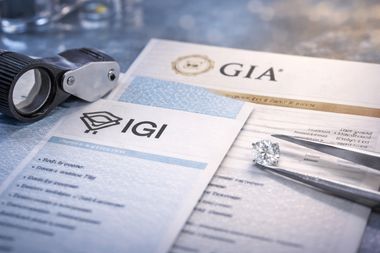
If you’re shopping for pre-owned diamond jewelry online, “IGI authentication” can sound reassuring, but also vague. Many buyers assume it’s just another word for “having a certificate.” Others think it’s a marketing badge that doesn’t change real risk.
In reality, authentication matters because it answers the most important question in pre-owned jewelry:
Does the item you’re buying actually match what’s being claimed, before it reaches you?
This guide explains what IGI authentication means in practical terms, what it typically helps confirm, what it does not guarantee on its own, and why process matters as much as paperwork when you’re buying pre-owned.
Authentication vs certification: the difference buyers should understand
A grading report (often casually called a “certificate”) describes what a gem lab observed about a specific stone at the time it was examined. It can be valuable, but it doesn’t automatically protect you from the most common pre-owned risks:
The mounted stone doesn’t match the document
Condition issues aren’t disclosed clearly
Key details are estimated rather than verified
The transaction process leaves the buyer carrying all the uncertainty
Authentication is about closing that gap: confirming the jewelry and/or stone aligns with the listing claims and documentation, so you’re not relying on trust alone.
On GEMGEM, the buying journey explicitly positions IGI authentication as a pre-delivery step to ensure the item is genuine before it ships to the buyer.
What “IGI authentication” means on GEMGEM
GEMGEM describes a trust model with multiple layers, Seller ID verification, Item detail verification, and IGI authentication before delivery, built into the buying process.
In plain language, it means your purchase is designed to move through steps that reduce buyer risk:
Seller is verified (identity verification layer)
Item details are reviewed before listing (listing accuracy layer)
After you purchase, the item is sent to IGI before delivery (authentication layer)
Buyer protection + payment protection are tied to the verification process (process layer)
This is fundamentally different from open marketplaces, where the buyer often has to “figure it out after it arrives.”
What IGI authentication is trying to protect you from
Authentication is not about making shopping “perfect.” It’s about reducing the highest-impact failures that cause buyer regret:
1) The item doesn’t match the listing
Example: the ring is described as one set of specs, but the physical piece differs (intentionally or unintentionally).
2) The paperwork exists, but doesn’t match the item in hand
A document can be real, yet still be unrelated to the exact stone currently set in a pre-owned piece.
3) “Estimated” details presented as facts
A cautious buyer needs clear, verifiable details, not guesswork.
On GEMGEM’s buying process page, it notes that IGI verification goes beyond existing certifications and includes authentication for both the certificate and the jewelry, and that items failing the verification are returned.
What happens during an authentication step (practically)
Every lab and workflow has its own procedures, but for a buyer, a useful way to think about authentication is:
It’s a professional check that helps confirm the item you’re purchasing matches its claimed identity and key attributes.
For pre-owned jewelry, that usually means validating the basics a buyer needs to feel safe:
The piece is real fine jewelry (e.g., genuine precious metal, real gemstones/diamonds as described)
The main stone(s) align with stated characteristics and documentation
The item is consistent with its listing description enough for the marketplace to stand behind it
GEMGEM ties this to its Authenticity Guarantee positioning, stating items are IGI-authenticated before delivery as part of its authenticity promise.
Why authentication matters more for pre-owned than for brand-new retail
In brand-new retail, you’re usually buying from a single controlled supply chain. In pre-owned, items can have a history:
resizing and repairs
re-setting stones
replaced side stones
wear that isn’t obvious in photos
That doesn’t mean pre-owned is risky by default. It means pre-owned needs a stronger verification layer, because the item’s history can’t be assumed.
This is why GEMGEM emphasizes process safeguards like buyer protection and authentication before delivery.
What authentication does not replace
Authentication is a major trust layer, but it doesn’t replace smart buying basics:
It doesn’t replace understanding diamond quality
If you’re comparing options, learning the basics (cut, color, clarity, carat, and what matters to you) still helps you shop confidently. GEMGEM’s Diamond Guide is a good evergreen reference for that.
It doesn’t automatically mean “perfect condition”
Authentication is about genuineness and match-to-claim. Condition transparency still matters, especially for prongs, pavé, and overall wear.
It doesn’t remove the need for a clear protection policy
What protects you operationally is a marketplace policy and process that handles mismatches or issues fairly. GEMGEM outlines this via its Buyer Protection page.
A simple checklist: how to shop smarter when you see “IGI authenticated”
When you’re browsing pre-owned jewelry, here’s how to use authentication information in a practical way:
Prefer listings and categories where authentication is standard
Start with structured categories and compare like-for-like:
Earrings: https://gemgem.com/en/category/earring
Necklaces: https://gemgem.com/en/category/necklace
Bracelets: https://gemgem.com/en/category/bracelet
Pendants: https://gemgem.com/en/category/pendant
Loose diamonds: https://gemgem.com/en/category/diamonds
Treat “report/certificate” as evidence—not the whole safety system
A report helps describe a stone; authentication + marketplace process reduces mismatch risk.Read the buying process like a protection plan, not like marketing
Understand what happens between payment and delivery. GEMGEM’s “How to buy” page lays out the steps and explicitly places IGI authentication before delivery.Know where to go when you have questions
A good help center matters for cautious buyers: https://gemgem.com/en/help-center
Bridge: why marketplace process matters more than price
For cautious buyers, the real decision is rarely “Is it cheaper?” The decision is:
Do I understand what I’m buying?
Is the item verified before it gets to me?
If something is off, is there a defined protection path?
That’s why process-driven marketplaces can feel materially safer than random sellers, because the safeguards are built into the transaction itself, not added as an afterthought. GEMGEM’s Buyer Protection + Buying Journey pages are meant to communicate those safeguards clearly.
Conclusion
“IGI authentication” is meaningful when it’s part of a real workflow, not just a label. For pre-owned jewelry, authentication helps reduce the highest-risk failure: a mismatch between what’s claimed and what arrives.
If you’re a cautious buyer, the best next step is to browse verified categories, compare listings with clear specs, and rely on a marketplace process that checks authenticity before delivery, so you can shop pre-owned with confidence, not guesswork.